

Join the Project

EYW wants your food photos!

Fish 'n Chips

England
liaht

Upload a photo now

Food Memories

EYW wants your food stories!

Spiced Roasted Garbanzo Beans

Morocco
hitripper

This dish makes a delicious side dish or snack. Not sure of origins, but it is found in North Africa areas. The Moroccan mashed spice mixture blend of garlic, cumin, cayenne pepper in olive oil that... Read more

Write a Food Memory now

 
We Have a Winner! AFAR contest, Africa edition

Read the winning Food Memory, about eating fish on the shores of Lake Victoria in Kenya. The author, user alexfhalpern, wins a yearlong subscription to fabulous travel magazine AFAR, courtesy of AFAR Media.
 

Learn more

Origins: Pueblo chile Yasmin Ghahremani November 1, 2011

It’s hard to find a restaurant in Pueblo, Colorado, that doesn’t serve green chiles. This is prime pepper country, a smaller—and, some would argue, tastier—alternative to Hatch, New Mexico.

In autumn, at harvest time, the scent of roasting chiles wafts from roadside stands, supermarkets, and the annual Loaf ’N Jug Chile and Frijole Festival, which I was lucky enough to catch this September. (Among pepper enthusiasts, the preferred spelling of the capsicum fruit is chile. The dish containing meat, chile, and vegetables, like the one we tried in Denver, is chili.)

The chiles are roasted over an open flame in rotating black-wire drums, and then hosed down in a cloud of steam. It’s hypnotizing to watch, but will sear your eyes if you get too close.

At the festival, I ask a farmer what made this area so special for pepper growing. “The cool nights are what create the thickness and that meat in our chiles,” says Shane Milberger, the owner of Milberger Farms, one of the establishments that lie just east of Pueblo on the St. Charles Mesa, a 17-mile stretch along the Arkansas River Valley. [See EYW’s Q&A with Shane here.]

Like many farmers here, Milberger grows a variety of peppers: mild and hot Anaheim, Fresno, and extra hot. But he’s most proud of the Pueblo chile, also known as the Mira Sol (“looking at the sun” in Spanish) because it grows upward. “It has the most flavor,” he says.

The pepper packs a fair punch—between 5,000 and 20,000 Scoville Heat Units, the measurement method used to rank chile heat. That’s comparable to a moderate jalapeño pepper. At the festival, I try a chile wrap, a tortilla layered with roasted Pueblo chile, cheese, and beans. It’s hot enough to make my nose run, but that didn’t keep me from polishing the whole thing off.

After all, it’s not every day I get to eat a Pueblo chile. The pepper is unique to the Mesa. No one quite knows where the first plant came from, but around 1912 an Italian immigrant was the first farmer to grow the chile. It remained largely confined to ethnic communities until the 1970s, when Mexican food became a mainstream hit.

In the 1980s and ’90s, as Pueblo’s steel industry collapsed, the community redefined itself through the Pueblo chile. In 1995, the chamber of commerce held the first Chile and Frijole Festival. Pete Giadone was the only farmer who brought chiles that year, and he sold out to the 5,000 attendees. Other growers liked what they saw and began converting their fields to chiles. But most of them lacked a key marketing item: a roaster. Chiles need to be roasted before they can be frozen, an essential process for extending the lifetime of the product beyond a few days.  

Giadone began making and selling roasters for $1,000 a piece to area farmers, and by 1999 a dozen farmers were roasting chiles from sunup to sundown for three days before the festival. Some 25,000 people showed up that year.

Aficionados use Pueblo chiles in salsa and chili verde (green chile stew), on nachos and pizza, in pasta, and for the most classic Pueblo dish: the slopper, a hamburger swimming in chili verde and topped with chopped onions (pictured above). I even try some goat cheese studded with Pueblo chiles from Milberger Farms.

Farmers in other areas have tried to grow the Pueblo chile, but nowhere else has the same combination of hot days, cool nights, sandy loam soil, and abundant irrigation water. These days the festival draws 100,000 people from all over the U.S. to a rejuvenated historical district and river walk. The transformation of Pueblo’s identity from gritty steel town to heritage tourist destination is complete. To which I say: Keep the antacid handy. I’ll be back.

You can visit Milberger Farms and other farms on Highway 50 East, heading out of Pueblo. Or check out the next annual Chile and Frijole Festival, which is always held the last weekend in September.

Tags: food origins

Comments

Origins: Cranberries Laura Siciliano-Rosen November 21, 2010


Cranberries. I don’t think of them too often, unless I’m throwing a handful of dried ones into my salad. Or, you know, it’s this time of year, when cranberry sauce makes its annual appearance in the Thanksgiving spread. But cranberries are an important fruit to the U.S., not only because of their more recently publicized “superfruit” antioxidant qualities, but because they’re one of the few fruits that originated on North American soil. They were a staple in the diets of Native Americans, who passed along the wild fruit’s benefits to the Pilgrims when they arrived in the early 1600s. Cultivation of the berries began on Cape Cod in 1816; commercial harvesting followed in 1847. Today, southeastern Massachusetts has more than 14,000 acres of cranberry bogs—some 900 bogs—and trails only Wisconsin in production of the fruit in the U.S. (New Jersey, Oregon, and Washington also produce cranberries, though in much smaller numbers.)

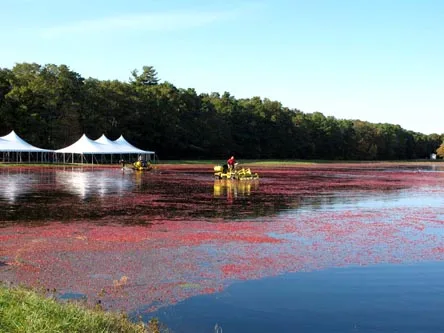
A few weeks ago in Cape Cod, we had the good fortune to witness a cranberry harvest, which happens every fall when the fruits reach their peak flavor and crimson color. We’d been in town for a mid-October wedding and had no idea it was harvest season until a local friend mentioned it. Scott and I are frequent visitors to the Cape and are familiar with the area’s many cranberry bogs, but we usually visit in summer, when they look like nothing more than dry, low-lying, shrub-covered fields. For the harvest, however, the soft, marshy bogs are flooded with up to 18 inches of water; water-reel harvesters are used to loosen the berries from their vines; and—the cool part—the berries, which contain pockets of air, float to the surface, where they’re corralled and loaded onto trucks.  

You can often observe a cranberry harvest from the road, as was the case at the Coonamessett bog—a bog first developed in 1890—we passed off of John Parker Road in Falmouth. Driving around a bend, we suddenly glimpsed a scarlet carpet of cranberries floating atop an ephemeral lake, glistening in the sun—a glorious vision only seen a handful of days a year. That this harvest coincides yearly with the multicolored fall foliage typical of the Northeast is almost unfair to the rest of the country.

We pulled over, walked around, picked up some floating berries at the bog’s perimeter, even ate a few—not really recommended, as they’re bitingly tart. The guys in waders and on machines waved and went about their business, oblivious (or accustomed) to our picture-taking, surrounded by the berries that would perhaps soon meet their fate in Ocean Spray packaging around the world—or on my own dinner table at Thanksgiving. Here, it all begins.

Tags: food origins

Comments


EYW City Guides

Are you going somewhere and wish you could take all of a city’s EYW info with you? With EYW’s printable City Guides, you can! Don’t miss out on any local foods or drinks during your next trip.

View Available City Guides


Forgot password